
Determination of stresses at the inclined sections in tension (compression) in two directions
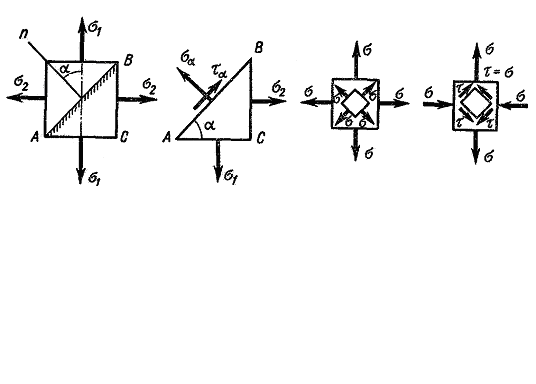
Let us consider a general case of the plane stress state, when two principal stresses (  in Fig. 2.7 a) differ from zero.
The indices for denoting the principal stresses are put so as the 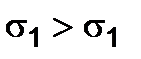 inequality is observed. We shall count off the positive
  angle between the
  direction and the normal to the arbitrary section against the clock.
The angle between the  stress direction and the plane is equal to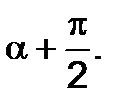
The  and
and  stresses at the arbitrary inclined section can be determined from the equilibrium condition of the ABC trihedral prism (Fig. 2.7 b) or calculated by the formulae (2.3) and (2.4) by summing the stresses caused by
  and the stresses caused by
  . As a result we get
| a) b) c) d) |

wherefrom
 (2.8)
(2.8)
further,

wherefrom
 (2.9)
(2.9)
From the formula (2.9) it is evident that the maximum shearing stresses are equal to half the difference of the principal stresses:
 . (2.10)
Special cases.
The first case. Let us consider the stress state, under which 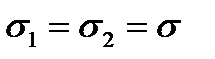 (Fig. 2.7 c).
In this case for all sections passing through the point under study the shearing stress  is equal to zero, and the normal stress has the same value
 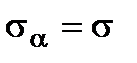 . That kind of the stress state is called the uniform plane tension (or compression).
The second case. Let us consider the stress state as presented in Fig. 2.7 d, characterized by the principal stresses 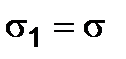 and
and 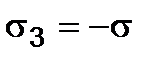 . Then,
  .
.
Determine the stresses at the sections having the same slope to the directions  and
and  i.e. at
  = 45° and
  = 135°.
We get 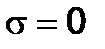 ;
; 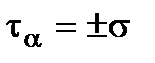 by the formulae (2.8) and (2.9). This stress state is called the pure shear.
Дата добавления: 2020-10-25; просмотров: 800;
Поиск по сайту
Узнать еще
- A lot of machine details in their function time are repeatedly subjected to variable loads stresses in time.
- Calculating stresses under the uniformly accelerated motion
- Combined axial tension (compression) and bending
- Determining displacements and stresses under the impact
- Determining the internal forces by the method of sections. Stresses
- Determining the principal stresses and the principal planes position
- Determining the stresses in the round section bar
Публикации по технике и механике
Публикации по биологии
Публикации по информатике
Публикации по строительству
Публикации по физике
Публикации по химии
Публикации по электронике

Публикации по искусству
Публикации по географии
Публикации по медицине